

The Power of the Pause
Most workplace conflicts, poor decisions, and leadership breakdowns don't come from a lack of skill. They come from the half-second we never learned to use.
You have felt it. The email that makes your chest tighten. The interruption in a meeting that warms your face. The comment that lands as a slight. In that instant, something ancient takes over — and if you are not careful, it answers on your behalf.
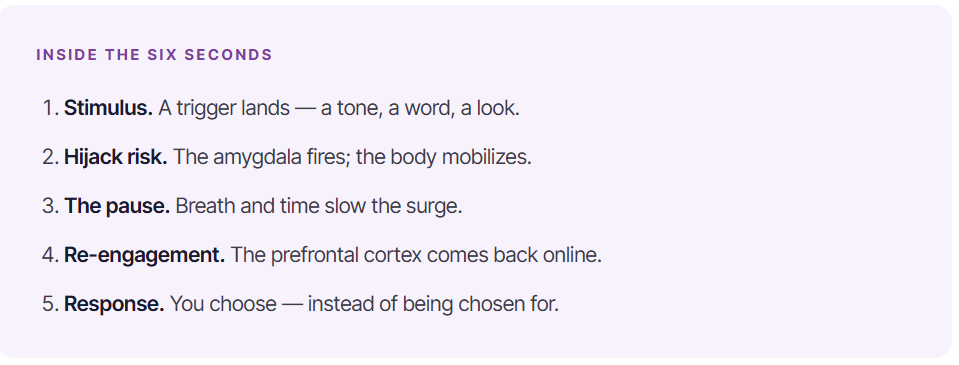
That instant has a name. Psychologist Daniel Goleman called it the amygdala hijack — the moment when the brain's emotional alarm overwhelms the rational brain, bypassing the slower, more considered processing of the neocortex. Under strong arousal, fear or anger can trigger a fight-or-flight-or-freeze response before the frontal lobes have decided whether the threat is even real.
The mechanism is elegant and fast. Sensory input arrives at the thalamus, which routes a crude, high-speed copy straight to the amygdala. If it detects a pattern that matches a stored threat, it fires—releasing adrenaline and cortisol and mobilizing the body—milliseconds before the thinking brain can weigh in. For our ancestors, that speed meant survival. In a modern meeting, it means saying the thing you will spend the afternoon regretting.
The reset that lives in the space
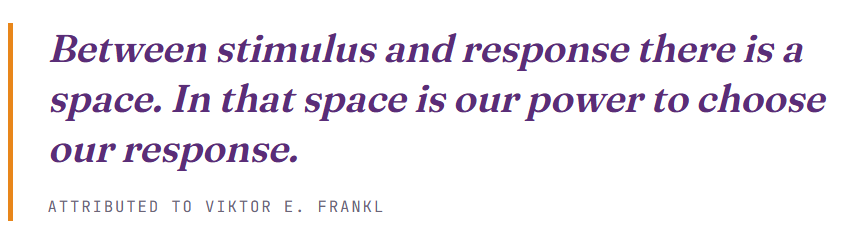
Here is the good news the neuroscience delivers: the hijack is not the end of the story, only the beginning. When you pause — even for six to ten seconds — you give the prefrontal cortex, the brain's rational center, time to come back online. A pause is not avoidance or weakness. It is a neurobiological reset: enough space for the thinking brain to re-engage so that logic, empathy, and self-control can return to the room.
This is where emotional intelligence lives. Goleman's framework identifies four domains — self-awareness, self-management, social awareness, and relationship management. The pause is the practical hinge between the first two. It is the moment self-awareness becomes a choice.
The goal is not to silence the amygdala. An alarm that never sounds is a liability too. The work is narrower and wiser: to widen the window between what happens to you and what happens through you — so genuine threats still get your speed, and everything else gets your judgment.
Reaction is what the moment does to you
A reaction is fast, automatic, and emotionally satisfying — for about four seconds. A response is slower, deliberate, and aligned with who you actually want to be. Both begin with the same trigger. What separates them is a pause you can learn to insert on purpose.
Consider a familiar scene. You are mid-sentence in a meeting, and a colleague cuts you off. The old script runs instantly: your chest tightens, your face warms, and a sharp reply is already forming. Reacting here is easy, and honestly, it would feel good. But it would help neither the conversation nor the relationship.
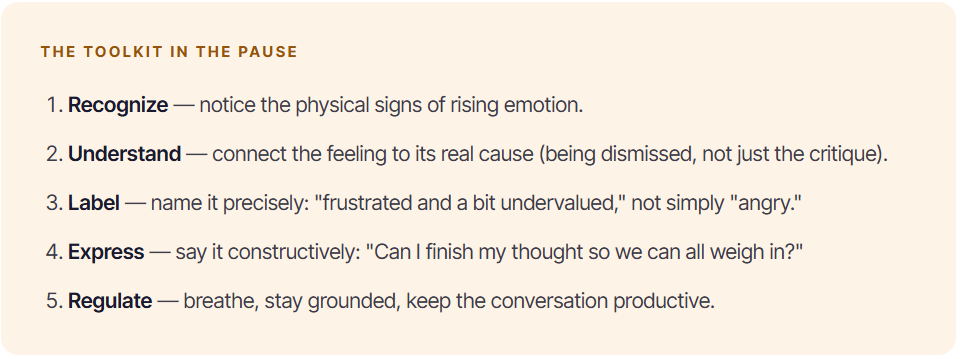
Now re-run the moment with one small shift. The interruption happens. You notice the tightening — and instead of firing, you pause. In that breath, a simple toolkit becomes available.
Why labeling works
The move that looks softest — naming the feeling — has the hardest science behind it. Research on affect labeling found that putting feelings into words measurably reduces activity in the amygdala. Clinicians summarize it as a rule worth memorizing: name it to tame it. The precise word does what the vague one cannot. "Angry" keeps you hot; "dismissed" points you toward what you actually need to say.
Notice what the pause is not. It is not suppression, and it is not becoming robotic. Emotional regulation does not mean you stop feeling things deeply. It means you can feel something strongly and still stay in the driver's seat.
Leadership isn't tested when everything is going well
It's tested when someone disagrees with you. When someone disappoints you. When someone cries, quits, or challenges your authority. That is when emotional intelligence becomes visible — and when its absence becomes expensive.
In business, instant reactions and rapid replies often rule the day. Yet every seasoned leader eventually discovers an underestimated instrument hiding in plain sight. A team does not only hear what a leader says; it reads how the leader arrives at it. A measured pause signals that the matter is being weighed, not merely deflected — and it gives everyone else permission to think before they speak. In this way, the leader's pause becomes contagious, and the whole room grows more deliberate.
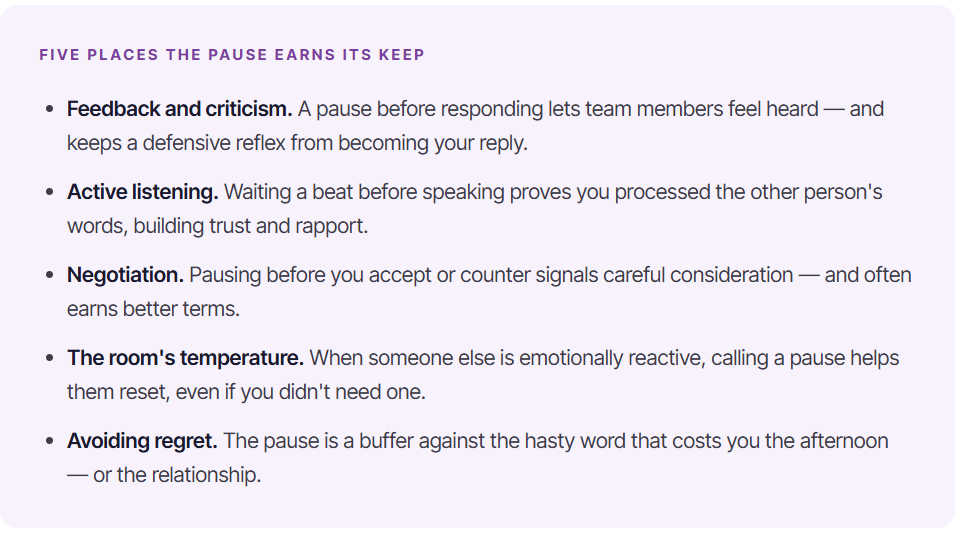
Goleman was explicit about the stakes between people. Self-control, he wrote, is crucial when facing someone in the throes of a hijack — precisely so you avoid a complementary hijacking of your own. Two dysregulated nervous systems resolve nothing. The leader's job is to be the one who stays regulated, and thereby to lend calm to the room.
Myths worth retiring
Emotional intelligence still carries a reputation problem. It gets filed under "soft skills," which in most organizations is shorthand for optional. Four corrections are overdue.
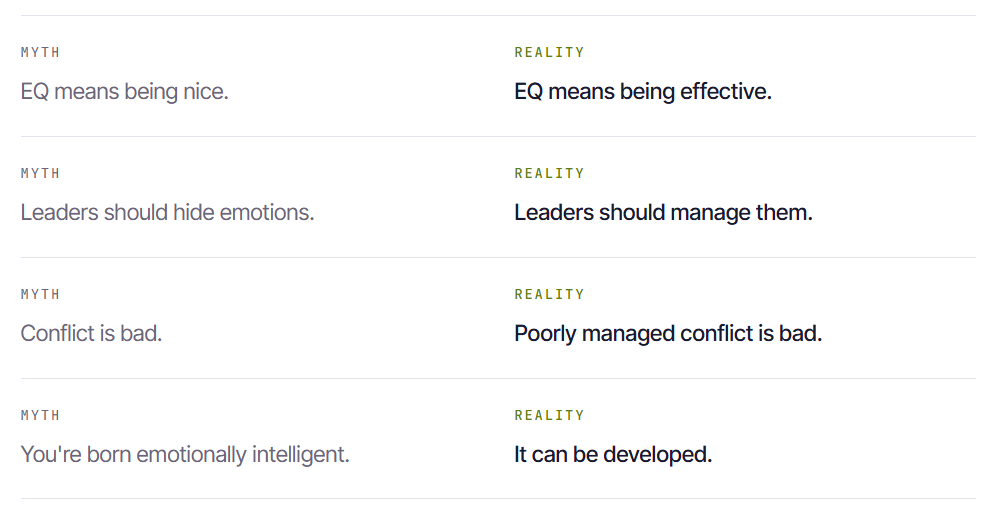
That last one matters most. Unlike IQ, emotional intelligence is trainable — which is precisely why it belongs in a development plan rather than a personality assessment.
Why is this skill appreciated, not depreciated
There is a common assumption that as technology absorbs more analytical work, the human skills become decorative. The opposite is happening. As machines take on more forecasting, analysis, and coordination, leadership advantage shifts toward the capabilities machines cannot replicate: empathy, judgment, adaptability, and trust.
Leadership was long measured through technical expertise and operational control. When the answer is a prompt away, that authority erodes. What remains is helping people navigate uncertainty and changing expectations without losing clarity or confidence. Two findings from decision research make the point concrete.
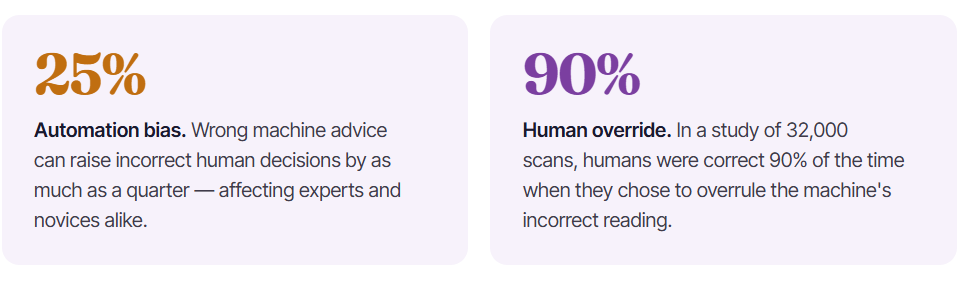
The human in the loop is not ceremonial. But staying genuinely in the loop requires the very capacity the pause protects — the willingness to slow down, question a confident answer, and hold your own judgment. Wave enough answers through because they arrive looking professional, and that muscle atrophies.
Building a pause you can actually use
The pause does not have to be long to be powerful — a few seconds will do. But it does have to be available, and availability is a matter of practice. You cannot install a pause button in the middle of a crisis. You build it in the ordinary moments, so it is there when the extraordinary ones arrive.
The fastest route back to the thinking brain runs through the lungs. Controlled breathing brings oxygen to the prefrontal cortex and interrupts the stress cascade. Box breathing is a reliable reset: inhale for four counts, hold for four, exhale for four, hold for four. One or two rounds is often enough to lower the surge from red to amber.
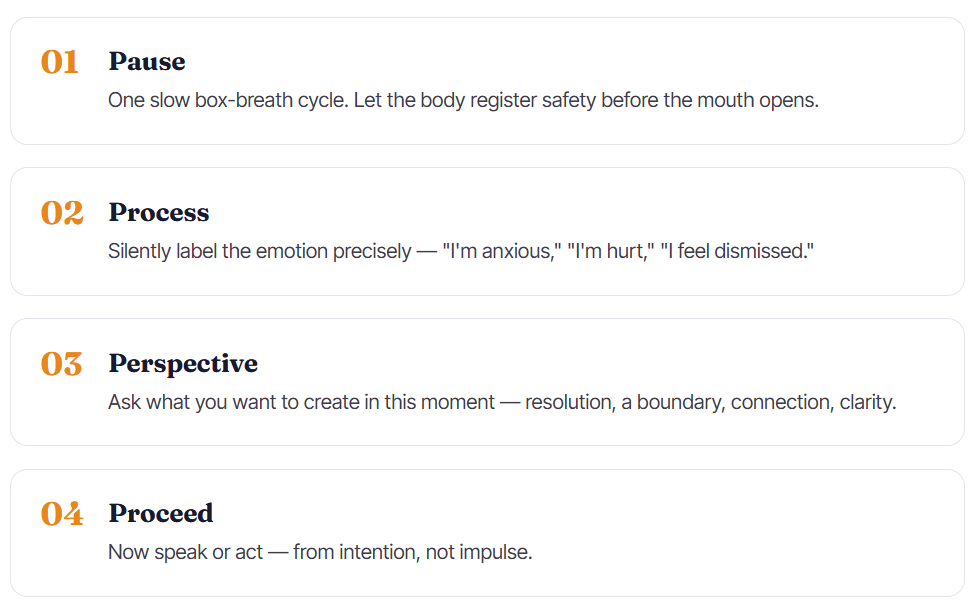
Don't wait for conflict to practice. Use the small frictions of an ordinary day as your training ground — traffic, long queues, a slow download, a device that won't cooperate. Each one is a free, no-consequence rep. When the pause is grooved in these moments, it shows up unbidden in the moments that matter.
And hold it lightly. This is not about getting it right every time — it is about being present enough to choose how you show up when emotions run high. Some days the pause will save the conversation; some days you will remember it a beat too late. Both are practice. The reps still count.
The thing people actually remember
After more than thirty years working with leaders across manufacturing, government, nonprofit, and corporate organizations, one pattern holds more reliably than any other:
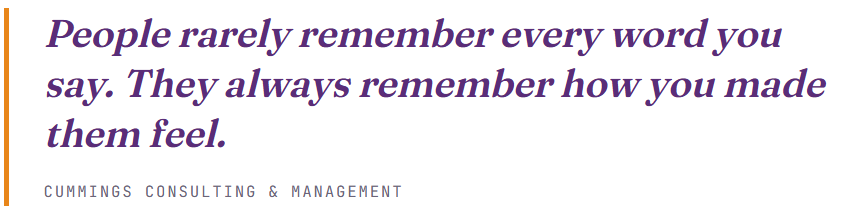
That is why emotional intelligence is not a soft skill. It is a leadership skill. The most effective leaders don't eliminate emotion — they learn how to manage it. And the management begins in a space most of us have never been taught to notice.
Your greatest leadership decisions aren't made in the heat of emotion. They're made after the pause.
Emotional Intelligence for Workplace Success
Build the pause deliberately.
A four-hour interactive masterclass in self-awareness, communication under pressure, and navigating difficult conversations with confidence. You’ll leave with a practical toolkit and a personal action plan — not a binder of theory.
Reserve your seat → learneq.cummingscm.comReferences
Bradberry, T., & Greaves, J. (2009). Emotional intelligence 2.0. TalentSmart.
Brackett, M. A. (2019). Permission to feel. Celadon Books.
Goleman, D. (1995). Emotional intelligence: Why it can matter more than IQ. Bantam Books.
Goleman, D. (1998). Working with emotional intelligence. Bantam Books.
Kabat-Zinn, J. (2013). Full catastrophe living (Rev. ed.). Bantam Books.
LeDoux, J. E. (1996). The emotional brain: The mysterious underpinnings of emotional life. Simon & Schuster.
Lieberman, M. D., Eisenberger, N. I., Crockett, M. J., Tom, S. M., Pfeifer, J. H., & Way, B. M. (2007). Putting feelings into words: Affect labeling disrupts amygdala activity in response to affective stimuli. Psychological Science, 18(5), 421–428.
Netzley, M. (2026, June 19). Why the future of AI governance depends on human judgment. World Economic Forum.
Olson, B. (2026, July 9). Leadership in the age of AI: Human judgment is more valuable, not less. Forbes Books.
Siegel, D. J. (2010). Mindsight: The new science of personal transformation. Bantam Books.